With HP Lithon Examples
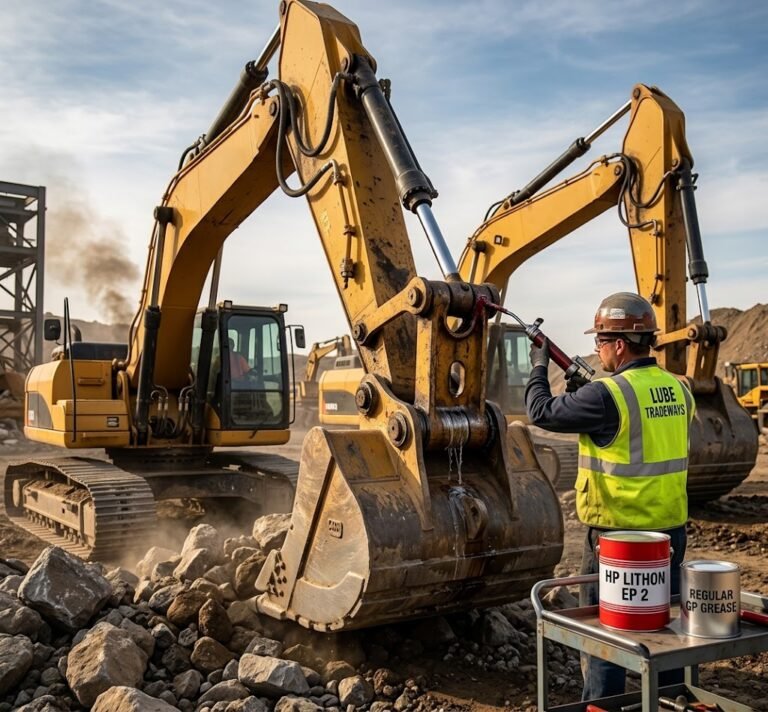
Heavy equipment operates under high loads, shock loading, vibration, heat, dust, and moisture. In these conditions, choosing the correct grease is essential. EP grease, or extreme-pressure grease, is formulated to protect metal surfaces when the load becomes too high for a conventional grease film.
Regular grease may be suitable for lightly loaded bearings and general-purpose applications. However, equipment such as rolling mills, cranes, conveyors, excavators, pumps, and heavy-duty machinery often requires an EP-grade grease matched to the manufacturer’s specifications.
For businesses purchasing HPCL lubricants in Chandigarh and across India, Lube Tradeways supplies HP Lithon industrial and automotive greases along with application guidance.
Important: Always check the equipment manufacturer’s lubrication chart, operating temperature, speed, load, NLGI grade, and grease compatibility before changing products.
What Is Regular Grease?
“Regular grease” generally refers to a general-purpose grease intended for normal loads and standard operating conditions. Grease itself normally contains three main components:
-
Base oil, which provides lubrication.
-
Thickener, which holds the oil in place.
-
Additives, which improve properties such as oxidation resistance, corrosion protection, or load-carrying performance.
A conventional grease can work well where the bearing or sliding surface experiences moderate loads, stable temperatures, limited shock, and controlled contamination.
Typical applications may include:
-
Lightly loaded electric-motor bearings.
-
General-purpose machinery.
-
Hinges, pins, and bushes under moderate load.
-
Low- to medium-duty bearing applications.
-
Equipment operating within normal speed and temperature limits.
However, general-purpose grease should not automatically be used in high-load equipment simply because it is cheaper or readily available.
What Is EP Grease?
EP grease contains additives designed to protect contacting metal surfaces under extreme pressure, shock loading, or boundary-lubrication conditions.
When a heavy machine starts, stops, changes direction, or experiences sudden loading, the normal oil film can become very thin. EP additives help reduce welding, scoring, and excessive wear between metal surfaces when the lubricant film is under severe stress.
EP grease is commonly considered for:
-
Heavy-duty bearings.
-
Steel-mill equipment.
-
Rolling mills.
-
Conveyors.
-
Cranes and material-handling equipment.
-
Mining machinery.
-
Excavators and loaders.
-
Heavily loaded pins and bushes.
-
Industrial pumps and general machinery requiring EP performance.
EP grease is not automatically the correct choice for every machine. The grease must still have the correct NLGI grade, base-oil viscosity, thickener type, temperature capability, and compatibility with the existing product.
EP Grease vs Regular Grease
The key difference is not simply that one grease is “stronger.” EP grease is formulated for a different operating environment—one in which pressure, shock, and metal-to-metal contact can become severe.
Why Heavy Equipment Needs EP Grease
1. Heavy loads can break down the lubricant film
Bearings and bushings in heavy machinery can experience very high contact pressure. Under these conditions, the protective oil film may become too thin to prevent surface contact.
EP additives provide additional protection during these demanding periods. This helps reduce the likelihood of surface damage, scoring, and premature wear.
2. Shock loading causes sudden stress
Cranes, crushers, conveyors, rolling mills, excavators, and mining equipment may not operate under a constant load. Sudden impact or load changes can place extreme pressure on bearing surfaces.
An EP grease is designed to handle these short-duration, high-stress conditions better than a standard grease.
3. Start-up conditions can be severe
At start-up, a bearing may experience high resistance before the grease has distributed throughout the contact area. This is particularly important in equipment that starts under load or after a long idle period.
The correct EP grease can support protection during these boundary-lubrication conditions.
4. High-load applications generate wear
Repeated high loading can increase wear even when the machine appears to be operating normally. A suitable EP grease helps create a more protective lubrication system and can support longer component life.
Actual results depend on correct application, relubrication frequency, sealing, contamination control, alignment, and operating conditions.
5. Heavy equipment operates in difficult environments
Industrial equipment may be exposed to:
-
Water spray.
-
Dust and dirt.
-
High temperatures.
-
Vibration.
-
Corrosive contaminants.
-
Long operating cycles.
A suitable grease must provide more than EP performance. Water resistance, corrosion protection, oxidation stability, mechanical stability, and pumpability are also important.
HP Lithon EP Grease Examples
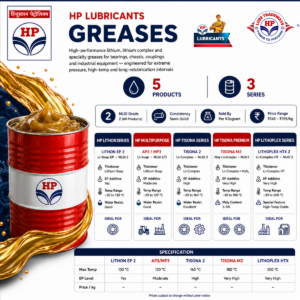
HP Lubricants offers several Lithon products for different applications and consistency requirements. Product selection should be based on the equipment manufacturer’s recommendation and the machine’s operating conditions.
HP Lithon EP 0 and EP 00
HP states that Lithon EP 0 and EP 00 are lithium-soap-based greases fortified with antioxidants and EP additives. The products are intended for applications where an NLGI 0 or NLGI 00 grade with EP properties is recommended. HP also identifies good pumpability as a feature of this series.hplubricants
According to the published HP product data:
-
Lithon EP 0 has a dropping point above 180°C.
-
Lithon EP 0 has a minimum four-ball weld load of 200 kg.
-
Lithon EP 0 has a minimum Timken OK load of 45 lb.
-
Lithon EP 00 is listed as NLGI 00.
-
Lithon EP 00 has a minimum four-ball weld load of 250 kg.hplubricants
These grades may be considered where the equipment requires a softer, more pumpable grease, but the correct grade must be confirmed against the lubrication system and manufacturer’s instructions.
HP Lithon EP 1 and EP 2
HP’s industrial grease information identifies Lithon EP 1 and EP 2 as EP-type products meeting the listed IS 7623:1993 and IPSS 1-09-005 requirements. HP Lithon industrial greases are described for applications including bearings and equipment used in steel mills, paper mills, electric motors and generators, pumps, conveyors, compressors, and machine tools.hplubricants
The NLGI grade matters:
-
NLGI 1 is softer and may be easier to pump in some systems.
-
NLGI 2 is a common consistency for many general bearing applications.
-
The correct choice depends on the grease delivery system, bearing design, temperature, speed, and manufacturer’s specification.
HP Lithon EP-2 Steel
HP Lithon EP-2 Steel is specifically described by HP as an extreme-pressure grease for sponge-iron steel plants and other general applications requiring high weld-load performance. HP lists a four-ball weld load of 315 kg, a dropping point above 180°C, and good mechanical stability.hplubricants
This type of application-focused product can be relevant for heavy-duty steel-plant machinery, but the product should be selected only after checking the bearing or component requirements.
HP Lithon RR 3T
HP Lithon RR 3T is described by HP as a lithium-soap grease meeting the IS 7623:1993 EP 3 type and Tata Motors’ EP-type grease requirement. The published data lists a typical dropping point of 180°C and a typical four-ball weld load of 250 kg.hplubricants
This product is an example of why grease selection must consider the application and required consistency. An EP 3 grease is not automatically a replacement for an EP 2 grease, and different NLGI grades should not be mixed without technical confirmation.
How to Choose the Correct EP Grease
Before selecting an EP grease for heavy equipment, collect the following information:
1. NLGI grade
NLGI grade indicates grease consistency. Do not choose a grade only by product name.
Check whether the equipment requires:
-
NLGI 00 or 0 for certain centralized systems or low-temperature pumping requirements.
-
NLGI 1 for applications requiring a softer grease.
-
NLGI 2 for many standard bearing applications.
-
NLGI 3 where a firmer grease is specified.
2. Operating temperature
Review both the normal operating temperature and the highest temperature during peak operation. A grease’s dropping point is not the same as its maximum continuous operating temperature.
3. Bearing speed
High-speed bearings may require a different base-oil viscosity and grease formulation from slow, heavily loaded bearings. A grease designed for high load may not be ideal for high-speed operation.
4. Load and shock loading
Identify whether the machine experiences:
-
Continuous heavy load.
-
Intermittent impact.
-
Vibration.
-
Start-up under load.
-
Reversing loads.
-
High contact pressure.
These factors help determine whether EP performance is required.
5. Water and contamination exposure
For steel plants, construction equipment, mining equipment, and outdoor machinery, water resistance and corrosion protection can be as important as EP performance.
6. Grease compatibility
Do not mix two greases simply because both are labelled EP. Different thickeners and additive systems may be incompatible.
When changing grease:
-
Check the technical data sheets.
-
Confirm thickener compatibility.
-
Purge the old grease if appropriate.
-
Clean the grease path when required.
-
Apply the new grease at the recommended quantity.
-
Monitor temperature, noise, leakage, and vibration after the change.
Common Mistakes to Avoid
Using any EP grease without checking the grade
EP 2, EP 1, EP 0, and EP 00 are not interchangeable in every application. The equipment manufacturer’s specified NLGI grade should be treated as a primary requirement.
Assuming a higher dropping point solves every problem
A high dropping point does not automatically mean that a grease is suitable for high-speed bearings, water exposure, low temperatures, or continuous high-temperature operation.
Overgreasing the bearing
Too much grease can increase churning, heat generation, seal damage, and energy consumption. Follow the manufacturer’s relubrication quantity and interval.
Mixing incompatible greases
Mixing can cause softening, hardening, oil separation, or loss of performance. Compatibility must be confirmed before combining products.
Ignoring contamination
Dirt, water, metal particles, and process chemicals can damage a component even when the correct grease is being used. Clean grease guns, fittings, storage containers, and application points are essential.
Selecting by price alone
The lowest purchase price may not be the lowest operating cost. Consider component life, relubrication frequency, downtime, labour, and failure risk.
When Regular Grease May Be Enough
EP grease is not required for every lubrication point. A regular multipurpose grease may be adequate when:
-
The load is moderate.
-
There is little or no shock loading.
-
The equipment operates within normal temperature limits.
-
The manufacturer specifies a non-EP grease.
-
The bearing speed and grease formulation are correctly matched.
-
The environment is clean and dry.
The correct grease is the one that meets the equipment’s requirements—not necessarily the one with the most advanced label.
Practical Example: Rolling-Mill Bearing
Consider a rolling-mill bearing exposed to high loads, vibration, heat, and occasional shock loading.
A suitable lubrication review should examine:
-
Required NLGI grade.
-
Bearing speed.
-
Operating temperature.
-
Water and scale contamination.
-
Relubrication quantity.
-
Existing thickener type.
-
Required weld-load performance.
-
Manufacturer’s approved products.
For an application requiring an EP 2 grease with high weld-load performance, HP Lithon EP-2 Steel may be evaluated because HP describes it for sponge-iron steel plants and lists a 315 kg four-ball weld load. Final selection should still be approved by the equipment or lubrication engineer.hplubricants
Frequently Asked Questions
Is EP grease always better than regular grease?
No. EP grease is better suited to high-load, shock-load, and severe-pressure conditions. A standard grease may be more appropriate for a machine that does not require EP performance.
Can EP 2 grease replace regular NLGI 2 grease?
Not automatically. Although both may have an NLGI 2 consistency, their additive systems and application requirements can differ. Check the equipment manual and grease compatibility before changing.
Can I mix HP Lithon EP grease with another grease?
Do not mix them without confirming compatibility. The thickener type, base oil, additives, and operating conditions must be reviewed first.
Is dropping point the same as operating temperature?
No. Dropping point is a laboratory property indicating when grease begins to lose its structure under a specified test. It should not be treated as the maximum safe continuous operating temperature.
Which HP Lithon grade is right for my machine?
The correct grade depends on load, temperature, speed, NLGI requirement, grease delivery system, water exposure, and the manufacturer’s specification. Lube Tradeways can help industrial buyers identify the relevant HPCL product information before ordering.
Final Takeaway
Heavy equipment often needs more than a general-purpose grease because high loads, vibration, shock, heat, and contamination can severely stress the lubrication film. EP grease provides additional protection for demanding applications, but the grease must still match the machine’s NLGI grade, temperature range, speed, compatibility, and relubrication requirements.
HP Lithon EP 0, EP 00, EP 1, EP 2, EP-2 Steel, and EP 3-type products serve different requirements. Lube Tradeways, an authorized HPCL industrial lubricant distributor and CFA based in Chandigarh, supplies HPCL lubricants and supports customers across industrial sectors including steel, manufacturing, power, mining, and automotive applications.lubetradeways
Need help selecting HP Lithon EP grease? Contact Lube Tradeways with your machine type, operating temperature, current grease, NLGI grade, and application details for a product recommendation.