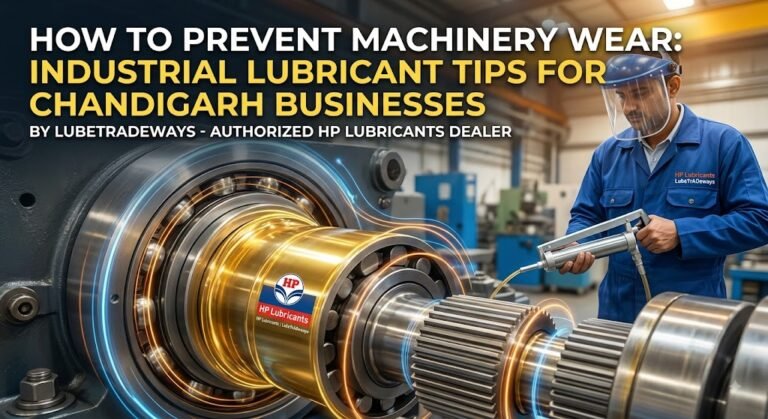
Introduction: The Hidden Cost of Machinery Wear in Chandigarh’s Industrial Belt

Once a machine goes down, every hour it remains broken on the shop floor is a dollar out the door. For companies operating in the bustling industrial belts of Chandigarh – whether in the manufacturing parks of Phase 1 11 in Mohali, the industrial estates of Panchkula, the auto parts dealers on Ambala Road, or the engineering firms of Baddi – the costs of unanticipated breakdowns in machinery are among the most controllable and yet the most consistently under-estimated costs in production. What is actually good news?
All but the most extreme premature machinery wear and catastrophic equipment failures can be traced back to one, preventable root cause. Lack or wrong Industrial Lubricant.
Based on their experience, the major bearing manufacturers have calculated that some 40% of all rolling bearing failures are due to lubrication factors wrong type of Industrial Lubricant; wrong amount of lubricant; wrong intervals of applying the lubricant; contaminated lubricants.
In a manufacturing environment where the cost of replacing a CNC machine tool is 2080 lakhs and the cost of lost production through unscheduled downtime is 10,00050,000 per hour there is a compulseing parabolic profit argument for correct lubrication.
This has been conceived and created by LubeTrADeways – authorized HP Lubricants dealer in Chandigarh Mohali Panchkula and tricity (the largest industrial sector of the country); to equip the local entrepreneurs with the practical steps they could implement today to dramatically lessen the machinery wear, prolong the life of plants and eradicate the leading causes of unplanned outages.
Be it you have a precision engineering workshop in Phase 8 of Mohali, or a food processing plant in Indian Colony of Panchkula, or plastic components manufacturing factory in Baddi, or heavy fabrication workshop on the outskirts of Chandigarh this guide is for you.
Why Machinery Wears Out: Understanding the Root Causes
Before diving into prevention strategies, it’s worth understanding exactly how and why machinery wears — because the prevention strategy flows directly from the failure mechanism.
The Four Primary Wear Mechanisms
1. Adhesive Wear (Galling & Scoring) When two metal surfaces slide against each other without adequate Industrial Lubricant film separation, microscopic surface asperities (tiny peaks on the metal surface) make contact, heat up, and momentarily weld together. As the surfaces continue moving, these micro-welds tear apart — removing material from one or both surfaces. In severe cases this manifests as visible scoring, galling, or seizure of sliding components.
Most common in: bearings running at low speed under high load, gears under heavy load, piston rings, slideways and guideways.
2. Abrasive Wear Hard particles — either metal debris from the equipment itself, or external contamination like dust, sand, or machining chips — act like sandpaper between moving surfaces. Even particles invisible to the naked eye (10–20 microns) can cause significant abrasive damage inside precision bearings and hydraulic systems.
Most common in: hydraulic systems with contaminated oil, gearboxes where metal filings accumulate, bearings in dusty environments (foundries, cement, stone crushing), open chain drives.
3. Fatigue Wear (Pitting & Spalling) Under repeated cyclic loading — particularly in rolling contact between bearing races and rolling elements, or between gear teeth — subsurface stress accumulates over time. Eventually, cracks initiate below the surface and propagate upward, causing material to break away in characteristic pits or spalls. Correct viscosity and EP additive chemistry significantly delay the onset of fatigue wear.
Most common in: rolling bearings (ball and roller), gears, cam followers.
4. Corrosive Wear Chemical attack on metal surfaces — typically from water contamination, acidic degradation products in aged oil, or chemical process contamination — removes material and roughens surfaces, accelerating all other wear mechanisms simultaneously. Lubricants with good rust and corrosion inhibitor packages dramatically slow corrosive wear.
Most common in: equipment exposed to coolant ingress, outdoor or humid environments, food processing equipment, chemical plant machinery.
Understanding which wear mechanism is dominant in your equipment — by examining wear patterns, oil analysis data, and failure modes — is the first step to selecting the right Industrial Lubricant solution.
10 Expert Industrial Lubricant Tips to Prevent Machinery Wear
Tip 1 — Use the Right Lubricant for Every Application (Not Just “Any Oil”)
The single most impactful action any Chandigarh industrial business can take is ensuring every lubrication point in the plant has the correct, specified lubricant — not the closest available alternative, not a cheaper substitute, and not whatever was used last time because no one checked.
Every piece of equipment — from a simple electric motor to a complex CNC machining centre — has a lubrication specification from its manufacturer covering:
- Lubricant type (oil vs. grease; mineral vs. synthetic; neat vs. water-miscible)
- Viscosity grade (ISO VG or SAE grade)
- Additive performance level (EP, anti-wear, anti-corrosion, anti-foam)
- NLGI grade (for greases)
- Specific approvals (OEM-approved brands or product specifications)
Using the wrong viscosity alone can cause severe problems. Too thin an oil fails to maintain the lubricant film under load — leading to metal-to-metal contact and accelerated wear. Too thick an oil generates excessive heat through fluid friction, increases power consumption, and can cause churning damage in gearboxes and bearings running at higher speeds.
Action for Chandigarh businesses: Pull out the maintenance manual for every major piece of equipment in your plant. Create a lubrication schedule that lists the correct HP Lubricants product for each point. Call your LubeTrADeways authorized dealer to cross-reference your current products against OEM recommendations.
Tip 2 — Manage Lubricant Quantity: Too Much Is as Harmful as Too Little
One of the most common and least-understood lubrication mistakes in Indian manufacturing plants is over-greasing bearings. It seems counterintuitive — surely more grease means better protection? — but excessive grease is actually a primary cause of bearing failure.
When a bearing is over-greased, the excess grease churns inside the housing, generating frictional heat that can raise bearing temperatures by 20–40°C above the normal operating temperature. This accelerated thermal exposure degrades the grease rapidly, leading to premature oxidation and loss of protective properties — exactly the opposite of the intended result.
The correct bearing grease quantity is typically 30–50% of the available void space in the bearing and housing — never 100%. For most standard bearings, the grease quantity can be calculated as:
G = 0.005 × D × B
Where G = grease quantity in grams, D = bearing outer diameter in mm, B = bearing width in mm.
For re-lubrication intervals and quantities, always refer to the bearing manufacturer’s specification. SKF, FAG, NSK, and NTN all publish detailed lubrication calculators for their bearing ranges.
Similarly, oil levels in gearboxes must be maintained precisely at the specified level — not above or below. Low oil level starves upper gears of lubrication. High oil level causes excessive churning, foam generation, and seal leakage.
Tip 3 — Follow a Written Lubrication Schedule (Not Just Tribal Knowledge)
In many small and medium-scale industrial businesses across Chandigarh’s Mohali and Panchkula industrial zones, lubrication is managed through operator experience and informal knowledge — “we oil the machine when it sounds bad” or “the mechanic knows which points need attention.”
This approach is a recipe for inconsistent maintenance, over-lubrication of some points and neglect of others, and catastrophic failures when experienced staff leave.
The solution is a written Lubrication Maintenance Schedule (LMS) — a documented list of every lubrication point in the plant specifying:
- Equipment name and location
- Lubrication point (bearing number, gearbox name, hydraulic reservoir etc.)
- Correct lubricant product (e.g., HP Lithon EP 2 grease or HP Enklo 68 hydraulic oil)
- Quantity per application
- Re-lubrication interval (weekly / monthly / quarterly / annually)
- Application method (grease gun, oil can, centralized system, oil change)
- Person responsible
A well-designed LMS — even a simple Excel-based one — transforms lubrication from a reactive firefighting activity into a proactive maintenance discipline that reliably extends equipment life.
LubeTrADeways helps Chandigarh area clients develop plant-specific lubrication schedules as part of our technical support service. Ask about this when placing your next lubricant order.
Tip 4 — Monitor Lubricant Condition: Don’t Wait for Failure
Most industrial businesses in India change lubricants based on fixed time or production hour intervals — which is far better than waiting for failure, but still not optimal. The best practice is condition-based lubricant management — changing oil only when analysis shows it has reached the end of its useful life, and catching incipient problems before they become failures.
Used oil analysis is a low-cost, high-value diagnostic tool that measures:
- Viscosity change — indicates thermal degradation or contamination
- Acid Number (AN) / Base Number (BN) — measures oxidation and additive depletion
- Water content — detects coolant or condensation ingress
- Particle count and ISO cleanliness — measures abrasive contamination level
- Wear metals (iron, chromium, copper, lead, tin) — identifies which components are wearing and at what rate
- Additive elements (zinc, phosphorus, calcium) — tracks additive depletion
In Chandigarh and the broader Punjab-Haryana region, used oil analysis services are available from several accredited laboratories, and HP Lubricants also offers oil analysis support through its technical services network.
Simple in-plant checks that any maintenance team can perform between lab analyses:
- Colour check — new oil is golden/amber; dark brown-black oil is oxidized
- Smell check — burnt smell indicates overheating; sour smell indicates bacterial contamination (in water-mixed fluids)
- Feel check — rub a drop between fingers; gritty texture indicates particle contamination
- Paper test — drop a small amount of oil on white paper; spreading ring pattern indicates water contamination
- Refractometer check — for water-miscible cutting fluids, measures concentration daily
Tip 5 — Keep Lubricants Clean: Contamination is the Enemy
Lubricant contamination — by water, by solid particles, by process chemicals, or by incompatible lubricants — is one of the leading causes of premature equipment wear and lubricant degradation in Indian manufacturing environments.
Research by major hydraulic component manufacturers has demonstrated that reducing hydraulic oil ISO cleanliness class by just two levels (from ISO 22/21/18 to ISO 18/17/14) can extend hydraulic pump and valve life by a factor of 2–5 times — without changing the oil, the pump, or anything else.
Key contamination control practices for Chandigarh industrial businesses:
Storage contamination control:
- Store lubricant drums horizontally (not vertically) to prevent water ingress through the bung seal during rain — this is particularly important during Chandigarh’s monsoon season (July–September)
- Store drums indoors or under covered shelter — direct sun exposure degrades oil and causes thermal expansion/contraction that pumps water vapour into the drum
- Use dedicated, labelled dispensing equipment for each lubricant type — never share funnels, pumps, or containers between different lubricants
- Keep drum tops clean before opening — debris on the top surface falls directly into the oil
In-service contamination control:
- Use breather filters on gearbox and hydraulic reservoir vents — standard metal breathers allow 10–20 micron particles to enter freely
- Install magnetic plugs in gearbox sumps to capture ferrous wear particles
- Use kidney-loop offline filtration on hydraulic systems to continuously clean oil below the system’s working particle count
- Ensure bearing housings have effective seals — lip seals, labyrinth seals, or felt seals depending on the application — to exclude dust and water
In North India’s industrial environment — with significant seasonal dust during April-June pre-monsoon periods, and monsoon humidity from July-September — contamination control deserves special attention and investment.
Tip 6 — Choose the Right Grease for Chandigarh’s Temperature Conditions
Chandigarh’s climate presents specific lubricant performance challenges that businesses in the Tricity region need to account for in their Industrial Lubricant selection:
Summer (April–June): Temperatures regularly reach 42–46°C ambient. Bearing operating temperatures in enclosed environments can exceed 80–90°C. Standard lithium greases with dropping points around 180–185°C are adequate, but businesses should ensure they are using greases with appropriate high-temperature oxidation stability — or upgrade to lithium complex greases (dropping point >260°C) for critical bearing positions.
Monsoon (July–September): High humidity and water ingress risk, particularly in older factory buildings and outdoor equipment. Calcium sulfonate complex greases — with outstanding water washout resistance — are the recommended choice for equipment exposed to humidity or water contact.
Winter (December–January): Chandigarh winters are genuinely cold, with temperatures regularly dropping to 2–8°C. Standard mineral oil-based greases and oils thicken significantly at these temperatures, which can cause inadequate lubrication at startup — a period when 80% of bearing wear in some applications occurs. Ensure lubricants used in outdoor or unheated equipment have sufficient low-temperature fluidity for winter startup conditions.
Recommended HP Lubricants products for Chandigarh climate conditions:
| Application | Summer Focus | Monsoon Focus | Winter Focus | Recommended Product |
|---|---|---|---|---|
| General bearings | High-temp stability | — | Low-temp startup | HP Lithon EP 2 |
| Outdoor equipment | — | Water resistance | Pour point | HP Lithon Complex 3 |
| Critical bearings | Max temp stability | Water resistance | — | HP Lithon Complex 2 EP |
| Hydraulics | Viscosity stability | Anti-rust | Low-temp flow | HP Enklo 46 / 68 |
| Gearboxes | Oxidation resistance | — | Pour point | HP Gear Oil EP 220 |
Tip 7 — Don’t Mix Lubricants: Incompatibility Causes More Damage Than Running Dry
Lubricant mixing is remarkably common in Indian manufacturing facilities — often occurring when a new product is introduced without fully purging the old one, or when a maintenance crew adds the nearest available oil to a running low system without checking what’s already inside.
Mixing incompatible lubricants can cause:
- Thickener system breakdown in greases — mixing lithium and calcium greases causes the thickener structure to collapse, turning a semi-solid grease into a runny oil that drains out of the bearing housing within hours
- Additive incompatibility in gear oils — mixing EP oils with different additive packages can cause additive precipitation, sludge formation, and loss of EP protection
- Emulsion destabilization — mixing different brands of soluble cutting oil concentrates can destroy emulsion stability, causing oil separation and loss of corrosion protection
- Foam generation — mixing oils with different anti-foam additive packages can result in severe foaming in hydraulic systems, causing pump cavitation and control instability
The simple rule: Never mix lubricants from different brands, different product lines, or different viscosity grades without first verifying compatibility with your lubricant supplier. When switching products, perform a complete drain and flush — never just top up with the new product.
LubeTrADeways tip: Colour-code your lubricant storage containers and dispensing equipment. Use red labels for gear oils, blue for hydraulic oils, green for greases, yellow for cutting fluids — whatever system works for your plant. Colour coding dramatically reduces accidental mixing errors.
Tip 8 — Train Your Maintenance Team: Human Error Is the #1 Lubricant Failure Mode
The most sophisticated lubricant in the world provides zero protection if it’s applied incorrectly, applied to the wrong point, or not applied at all because the maintenance team didn’t know it was needed.
In our experience working with industrial businesses across Chandigarh, Mohali, and Panchkula, human error in lubrication practices — wrong product selection, incorrect application quantity, missed lubrication points, inadequate purging when switching products — is the single most common root cause of premature equipment wear.
Key training areas for Chandigarh manufacturing maintenance teams:
- How to read and use a grease gun correctly (including understanding delivery volumes per stroke)
- How to identify each lubrication point on major machines and what product it requires
- How to check oil levels correctly (with the machine stopped and level, not running)
- How to recognize signs of lubrication failure — unusual noise, heat, vibration, oil discoloration
- How to handle lubricant storage and dispensing correctly to avoid contamination
- What to do (and not do) in an emergency — such as a machine running low on oil during a production shift
LubeTrADeways provides on-site basic lubrication training for maintenance teams of our Chandigarh-area customers — contact us to arrange a session for your plant.
Tip 9 — Use Genuine HP Lubricants from Authorized Dealers: Beware of Counterfeits
Counterfeit lubricants are a serious and growing problem across India’s industrial lubricant market. Industry estimates suggest that in some product categories and regional markets, counterfeit or adulterated products may account for 10–20% of total sales — packaged in convincing imitation containers that are nearly indistinguishable from genuine products to the untrained eye.
Counterfeit lubricants cause real damage:
- Fake gear oils without proper EP additives cause rapid gear and bearing failure under load
- Adulterated hydraulic oils with incorrect viscosity damage pumps, valves, and actuators
- Counterfeit greases with wrong thickener chemistry collapse in service, leaving bearings unprotected
- Fake engine oils with incorrect additive packages cause engine wear and corrosion far beyond normal
The financial damage from a single counterfeit lubricant-induced machinery failure — unplanned downtime, component replacement, possible production scrap — typically dwarfs the small price saving on the counterfeit product many times over.
How to ensure you’re getting genuine HP Lubricants products:
- Purchase only from HPCL-authorized HP Lubricants dealers — ask to see the dealer’s current authorization certificate
- Check the HP Lubricants holographic seal on packaging — genuine products carry a tamper-evident hologram
- Verify batch codes and manufacturing dates on the packaging against HP Lubricants’ verification systems
- Be suspicious of products priced significantly below the market rate for genuine HP Lubricants
LubeTrADeways is a fully authorized HP Lubricants dealer serving Chandigarh, Mohali, Panchkula, Ambala, Ludhiana, and surrounding areas. Every product we supply comes with full HPCL authorization documentation and genuine product guarantees.
Tip 10 — Plan Lubricant Purchases Strategically: Stock Smart, Not Just-In-Time
Many smaller industrial businesses in Chandigarh run lubricant procurement on a reactive basis — ordering only when stock runs out, sometimes mid-shift. This creates several unnecessary risks:
- Emergency purchases from unauthorized sources when regular suppliers are out of stock
- Production interruptions while awaiting lubricant delivery
- Premium pricing on urgent small-quantity purchases
- Temptation to use wrong products as temporary substitutes when correct products aren’t available
A smarter approach is strategic lubricant inventory management:
Calculate your consumption baseline: Track how many litres or kilograms of each product your plant uses monthly. Set a reorder point at 6–8 weeks of stock to allow comfortable reordering lead time.
Buy in bulk where practical: For your highest-volume products — hydraulic oil, gear oil, cutting fluids — purchasing in 210-litre drums rather than 20-litre cans typically saves 8–15% on unit price, and ensures supply continuity.
Consolidate your supplier base: Using one authorized dealer like LubeTrADeways for your complete HP Lubricants requirement gives you better pricing leverage, relationship-based service, and a single point of contact for technical support.
Plan for seasonal demand: Chandigarh industries often see higher production volumes in certain months — plan lubricant procurement to stay ahead of these peaks rather than scrambling during high-demand periods.
Industry-Specific Wear Prevention Tips for Chandigarh Businesses
Auto Parts & Component Manufacturers (Mohali Industrial Area)
Chandigarh’s Mohali industrial belt hosts a significant concentration of auto component suppliers serving Hero MotoCorp, Maruti Suzuki, and other OEM supply chains. Key lubrication priorities:
- High-volume CNC machining: Use HP Syntho Cut semi-synthetic cutting fluid for better sump life, lower maintenance cost, and cleaner machines vs. conventional soluble oils
- Press shop operations: HP Pressol stamping oil for progressive die operations — reduces die wear and improves panel surface finish
- Assembly line pneumatics: Ensure compressed air lubricators use correct FRL oil viscosity — over-oiling contaminates downstream tools; under-oiling causes premature pneumatic tool wear
- Heat treatment: HP Quench 68 for alloy steel component hardening — the most common grade for auto component heat treatment
Food Processing & Packaging (Panchkula Industrial Area)
Panchkula hosts several food and beverage processing facilities with strict hygiene and safety requirements:
- Mandatory NSF H1 food-grade lubricants for all lubrication points with incidental food contact risk — including conveyor chains, packaging machine bearings, mixer gearboxes
- Regular lubricant inspection — food processing environments expose lubricants to elevated temperatures, water, cleaning chemicals, and food product contamination; inspection frequency must be higher than in general manufacturing
- Sealed bearing selection — minimize re-lubrication requirements in food zones; sealed bearings factory-filled with food-grade grease reduce contamination risk
Plastic & Polymer Manufacturing (Baddi/Nalagarh)
The Baddi-Nalagarh industrial corridor — within easy supply reach from Chandigarh — hosts a large concentration of pharmaceutical and plastic manufacturing:
- Injection moulding machines: Hydraulic systems require very clean oil (ISO 16/14/11 or better); use HP Enklo HVI hydraulic oil with high VI for stable performance across temperature swings
- Tie-bar and platen lubrication: Heavy lithium complex or calcium sulfonate grease for high-load, intermittent-motion tie bar bearings
- Hot runner systems: Specialty high-temperature grease for nozzle and manifold bearing positions
Fabrication & Welding Shops
Chandigarh’s industrial Lubricant zones include many structural and precision fabrication businesses:
- Cutting operations: HP Ratak 22/32 neat cutting oil for CNC plasma table guide rails and lead screws
- Crane and hoist bearings: HP Lithon Complex 3 or calcium sulfonate grease for overhead crane wheel bearings — water and contamination resistant
- Welding positioner gearboxes: HP Gear Oil EP 220 for the worm gear reduction units common in welding positioners
HP Lubricants Product Guide for Chandigarh Industries: Quick Reference
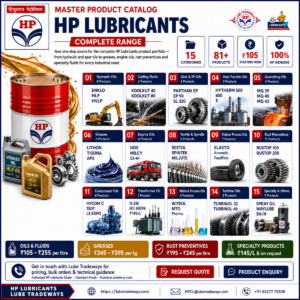
| Equipment Type | Recommended HP Product | Grade | Application |
|---|---|---|---|
| Electric motor bearings | HP Lithon 3 or HP Lithon Complex 2 | NLGI 2/3 | Grease gun, 30–50% fill |
| Industrial gearboxes | HP Gear Oil EP | ISO VG 220 / 320 | Oil change, 12 months |
| Hydraulic systems | HP Enklo 46 / 68 | ISO VG 46 or 68 | Condition monitoring |
| Air compressors | HP Compressor Oil | ISO VG 46/68/100 | 2000–4000 hour change |
| Slide ways / guideways | HP Slideway Oil | ISO VG 68/220 | Automatic or manual |
| CNC cutting fluid | HP Syntho Cut | Concentrate | 1:20–1:40 dilution |
| Gear cutting / broaching | HP Ratak 68 | Neat oil | Flood or drip |
| Heat treatment | HP Quench 68 | Medium quench | Tank temperature 40–80°C |
| Wire drawing | HP Dramon 460 | Heavy draw | Multi-die systems |
| Rust prevention | HP Rustilo 200 | Thin film | Dip or spray |
| Chain lubrication | HP Gear Oil EP 68 | ISO VG 68 | Drip or brush |
| Open gear drives | HP Open Gear Compound | Heavy | Spray or brush |
Where to Buy HP Lubricants in Chandigarh, Mohali & Panchkula
For industrial businesses in the Tricity region, genuine HP Lubricants products and expert application support are available through LubeTrADeways — your authorized HP Lubricants dealer serving the entire Chandigarh-Mohali-Panchkula industrial belt and surrounding districts.
Our supply coverage includes:
- Chandigarh Industrial Area (Phases 1 & 2)
- Mohali Industrial Area (Phases 1–11)
- Panchkula Industrial Area (Phases 1 & 2)
- Baddi, Nalagarh, and Solan industrial corridor (Himachal Pradesh)
- Ambala Industrial Area and Ambala Cantonment
- Ludhiana, Jalandhar, and the Punjab industrial belt
- Panipat, Sonipat, and Haryana industrial zones
What LubeTrADeways offers Chandigarh businesses:
Genuine HP Lubricants products — full range including industrial Lubricants oils, greases, metalworking fluids, and specialty lubricants, backed by HPCL authorization
Competitive pricing — direct dealer pricing with volume discount structures for regular industrial customers; bulk drum pricing available for high-volume users
Technical support — product selection advice, lubrication schedule development, on-site application training for your maintenance team
Prompt local delivery — covering Tricity and surrounding industrial areas with reliable delivery timelines
GST-compliant billing — proper tax invoices for all purchases, supporting your ITC claims
HSN code guidance — for correct GST classification of all lubricant categories
Conclusion: Prevention Costs a Fraction of the Cure
The mathematics of machinery wear prevention are compelling. A drum of HP Enklo 68 hydraulic oil costs ₹8,000–₹12,000. A hydraulic pump that fails due to oil contamination costs ₹25,000–₹2,00,000 to replace. A CNC machine bearing that fails due to wrong grease costs ₹2,000–₹15,000 for the part — plus production loss worth potentially many times more while the machine is down.
For Chandigarh’s industrial businesses — operating in a competitive manufacturing environment where margins are tight and on-time delivery is non-negotiable — a robust lubrication program is not a maintenance luxury. It is a fundamental business productivity tool that delivers measurable returns in reduced downtime, lower maintenance costs, longer equipment life, and better product quality.
The ten tips in this guide are practical, proven steps that businesses of every size — from a 5-person workshop in Mohali’s Phase 4 to a 500-person manufacturing plant in Panchkula — can implement progressively to transform their maintenance performance.
Start with the fundamentals: get the right lubricant specified for every machine. Build your written lubrication schedule. Train your team. Control contamination. Buy genuine products from an authorized dealer.
LubeTrADeways is here to support every step of that journey for Chandigarh-area businesses — with the products, knowledge, and local presence to help you keep your machines running at peak performance, every shift, every day.
Frequently Asked Questions
Q1. What is the best hydraulic oil for industrial machines in Chandigarh? HP Enklo 46 is recommended for most general industrial hydraulic systems. HP Enklo 68 is better for larger, slower systems or those operating at higher temperatures common in Chandigarh’s summer months. For systems with wide temperature swings between winter and summer, HP Enklo HVI 46 (high viscosity index) provides more stable performance year-round.
Q2. How often should I change gearbox oil in industrial equipment? For mineral oil-based gear oils like HP Gear Oil EP, the typical initial fill change is at 500–1,000 hours (to flush break-in wear metals), then annually or at 4,000–6,000 operating hours for normal industrial service. Synthetic gear oils can extend this to 8,000–12,000 hours with condition monitoring. Always check the equipment OEM specification first.
Q3. Which grease is best for bearing lubrication in Chandigarh’s climate? HP Lithon EP 2 (lithium EP grease) is a reliable general-purpose choice for most industrial bearings in Chandigarh’s conditions. For critical or high-temperature applications, upgrade to HP Lithon Complex 2 (lithium complex, dropping point >260°C). For outdoor or wet environments (common in Chandigarh’s monsoon season), calcium sulfonate complex grease offers superior water resistance.
Q4. How do I identify if my lubricant has been contaminated? Visual checks: darkened color (oxidation), milky appearance (water contamination), gritty texture when rubbed between fingers (particle contamination), or unusual odor (bacterial contamination in water-based fluids or overheating). For more reliable diagnosis, send a sample for used oil analysis — available through HP Lubricants technical services or independent labs serving the Chandigarh area.
Q5. Where can I buy genuine HP Lubricants in Chandigarh and Mohali? LubeTrADeways is an authorized HP Lubricants dealer serving the Chandigarh-Mohali-Panchkula Tricity industrial region. We supply the complete HP Lubricants industrial range — gear oils, hydraulic oils, greases, metalworking fluids, and specialty lubricants — with genuine product guarantee, competitive pricing, and prompt local delivery. Contact us to discuss your plant’s lubrication requirements.
Q6. What is the HSN code and GST rate for industrial lubricant in India? Industrial gear oils and hydraulic oils (petroleum-derived) are classified under HSN 2710 19 30 at 18% GST. Industrial greases fall under HSN 2710 19 40 at 18% GST. Specialty lubricants and metalworking fluids may fall under 3403 at 18% GST. All purchases for manufacturing use qualify for Input Tax Credit (ITC) under GST — ensure you receive a proper tax invoice from your authorized dealer.
Q7. Can wrong lubricant selection void my machine warranty? Yes — many equipment OEMs (particularly CNC machine manufacturers and bearing companies like SKF, FAG, and NSK) specify approved lubricants or minimum performance specifications as warranty conditions. Using a lubricant that does not meet the OEM specification can void warranty coverage for related failures. Always check OEM requirements before selecting lubricants for warranted equipment.