Introduction: Why Metalworking Lubricants And Fluids Are the Unsung Heroes of Manufacturing
Brass titanium aluminium steel stainless steel, silicon, and other metals, by necessity, are all required to be machined. When doing so they require just about as well as their occupants in the automotive, aerospace, and general manufacturing industries human helpers as well.
At present the metalworking lubricants and fluids market has become one of the biggest segment in the entire Industrial chemicals market. Today its market size is more than USD 10 billion and it is expected that it will keep increasing at a steady pace till 2032 because of increasing requirements of the growing automotive and aerospace manufacturing sector as well as United States defense and heavy machinery manufacturing sector.
In this brief write-up, we have discussed everything on the market including the current market situation segmentation growth initiatives challenges current trends, regional analysis, and competition strategies of leading players.
What Are Metalworking Lubricants And Fluids ?
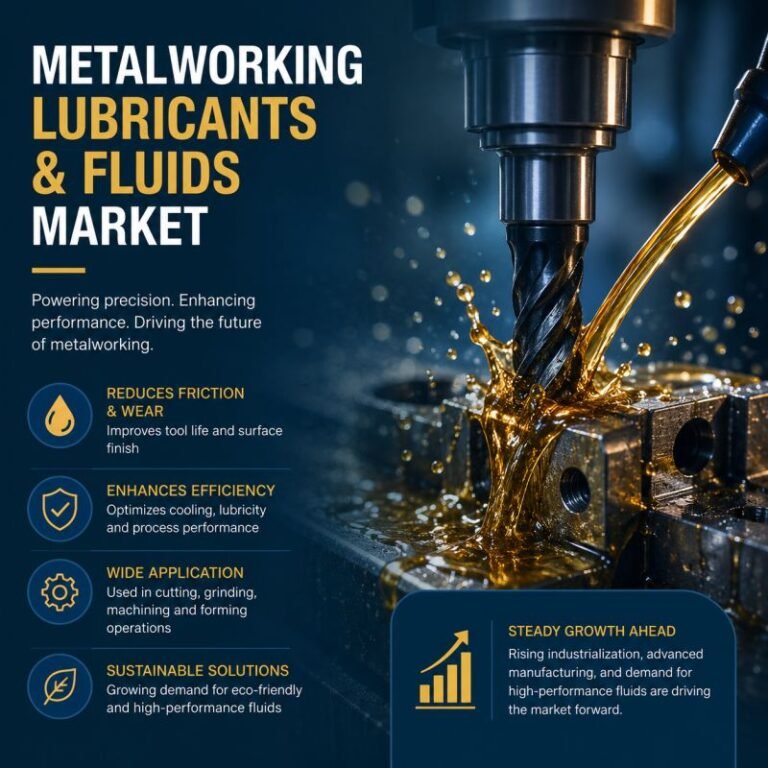
Metalworking lubricants and fluids are chemical substances applied during manufacturing processes such as cutting, grinding, drilling, milling, stamping, forming, and rolling of metal workpieces. Their primary functions include:
- Cooling — dissipating heat generated during metal cutting or forming
- Lubrication — reducing friction between the tool and workpiece
- Chip removal — flushing away metal chips and debris
- Corrosion protection — preventing rust on both workpiece and machinery
- Surface improvement — enhancing the dimensional accuracy and finish quality of finished parts
The fluids can exist in many compositionsstraight cutting oils, soluble oils (emulsifiable oils), semi synthetic, and fully synthetic.
The significance of knowing and understanding these differences is invaluable for such sought-after application managers, engineers, and market analysts to effectively operate in this niche, high technology, rollercoaster market.
Global Metalworking Lubricants And Fluids Market Overview
Market Size and Growth Projections
Metalworking lubricants & fluids (MWLFs) global market was valued at USD 10.2 billion in 2023 and is projected to reach USD 15.4 billion by 2032. It is predicted to grow with a CAGR of 4.7% in between the said period.
Key market indicators include:
- The increasing worldwide demand for automotive production and EV production, mainly driven by the developed economies but to some extent in the emerging economies as well.
- Growth of aerospace & defense budgets across the leading economies Fast industrialization of the Asia-Pacific and Latin America regions; Growing market demand for bio-based lubricant products with enhanced performance.
The market’s resilience — even through supply chain disruptions and raw material volatility — underlines the mission-critical nature of metalworking fluids in industrial production. No machining operation can run effectively without the right lubrication solution, making demand fundamentally inelastic in the short term.
Market Segmentation at a Glance
The market is broadly segmented by product type, application, metal type, end-use industry, and region — each offering unique insights into consumption patterns and growth opportunities.
Market Segmentation: Breaking Down the Metalworking Fluids Landscape
By Product Type
1. Straight Oils (Neat Oils)
Straight oils – petroleum-based or synthetic oils used without dilution. The advantage of using these is their outstanding lubrication capacity, In particular for tough applications, i.e. gear cutting broaching threading. They give the best tool care and surface finish although their use results in more mist and complicated waste disposal. They sell at high prices and are used in quality tool rooms and aerospace machining.
2. Soluble Oils (Emulsifiable Oils)
The predominately used type by volume, soluble oils are formulations of mineral oil-based concentrates when mixed with water will form emulsions, providing a mix of good cooling and lubrication at an economical price. They are used for general machining applications, like turning, milling and grinding and make up for most of the metalworking fluid volume used worldwide for say high production automotive parts.
3. Semi-Synthetic Fluids
Semi-synthetics combine the lubrication benefits of mineral oils with the cooling efficiency of synthetic fluids. They contain lower oil content (typically 5–30%) and offer improved biological stability, longer fluid life, and reduced foaming — making them ideal for medium-to-high-speed machining. This segment is gaining share as manufacturers seek a performance and sustainability compromise between soluble oils and full synthetics.
4. Synthetic Fluids
Fully synthetic metalworking fluids contain no petroleum oils and are engineered using chemical compounds such as esters, polyalkylene glycols (PAGs), or water-soluble polymers. They provide outstanding cooling efficiency, extended sump life, and superior rust protection — widely favored in high-speed CNC operations and precision grinding. While commanding the highest price point, synthetics offer the lowest total cost of ownership when sump life and disposal costs are considered.
By Application
Cutting & Machining Represents the other, largest application segment, which includes turning milling drilling, boring, and threading. Its demand is driven by the production of automotive and aerospace components, rendering it the highest-volume application segment of the overall global metalworking fluids market. Grinding Demands high-quality coolant formulations to counteract the extreme heat produced by abrasive processes.
High-precision grinding used in bearing manufacture, cutting tools, medical implants etc is a key application area demanding high-specification fluids with highly- effective heat transfer and lowlodue. Forming & Stamping Metal forming, deep drawing and stamping lubricants aid the protection of dies, cut down on springback and enhance part quality.
The automotive body panel industry is a major market for this area of lubricants, which must be formulated to provide for lubricity, weldability and compatibility with subsequent cleaning and coating processes.
Rolling — Rolling lubricants are applied in flat and long product rolling mills for steel and aluminum production. Their formulation must balance lubrication, surface cleanliness, and compatibility with downstream coating processes such as galvanizing and painting.
Drawing & Forging — High-pressure lubricants required for wire drawing, tube drawing, and hot/cold forging operations to protect both workpiece and die surfaces under extreme conditions of pressure and temperature.
By Metal Type
- SteelSupplies the extensive steel manufacturing sector which calls for and So consumes significant quantity of metalworking fluids.
- Aluminum expanding quickly with the advent of light-weight vehicle platforms, aircraft bodies and electronic enclosures; specialty non-stain formulations needed.
- Cast Iron Wall thickness 8mm15mm Machineda common requirement for many componentsSuch asUsed heavily in automotive engine blocks and cylinder heads and brake components, taping various shape and sizes from 8.15 mm.
- Copper AlloysElectrical and plumbing parts. Require special non-staining fluid formulations free of copper corrosion.
- Titanium & Superalloys For aerospace & medical applications. Require a high performance specialty lubricant because of excessive heat generated during machining.
By End-Use Industry
- Automotive the largest single end-use sector, representing more than 35% of all global demand for metalworking fluids Aerospace&Defensehi-value, precision-intensive need for specialty fluids capable of machining extreme materials like titanium, Inconel and carbon fiber composites.
- General Engineering & MachineryCover broad range of demand for general industrial machinery manufacturing such as pumps to gearboxes Oil & Gas Equipment Manufacturing of drill bits.
- Manufacturing of valves. Pressure vessels.
- Pipe threading. Medical DevicesUltra-precision machining of implants surgical diagnostic and therapeutic instrumentation that need to be free of contamination in fluid systems.
- ElectronicsPCB drilling, semiconducting package machining and radiator manufacturing. Necessitating in a residue free, clean fluid formulation.
Key Market Drivers: What’s Fueling Growth?
1. Booming Automotive Production, Including Electric Vehicles
Few sectors can match the automotive industry as the strongest single factor affecting mew usage. Despite the COVID-19 effect causing a dent in the numbers, over 90 million vehicles were produced globally in 2023 and the total continues to increase. But the new EVE emerging picture is set to stretch lubricant boundaries although EV models have fewer moving parts within the power train, they require high-precision machining for battery housings, electric motor casings, lightweight car bodies built from aluminium or magnesium, and power electronics heat sinks all all require sophisticated machining process and anti-wear air-mist lubricants for non ferrous metals and high volume manufacturing operations.
2. Expanding Aerospace and Defense Sector
With global defense budgets rising across NATO countries and beyond, and commercial aerospace rebounding strongly from pandemic-era lows, demand for precision-machined titanium, aluminum, and nickel superalloy components is surging. These difficult-to-machine materials require sophisticated, high-performance metalworking fluids that reduce tool wear, maintain tight dimensional tolerances, and deliver consistent surface integrity — positioning the aerospace sector as a high-value, high-growth segment for specialty lubricant manufacturers.
3. Industrial Automation and CNC Machining Expansion
This worldwide move to computer-controlled manufacturing is also changing metalworking fluid needs. Today’s CNC machining centers run at orders of magnitude faster feeds and speeds than manual equipment, creating many times the amount of heat generated, calling for fluids with even higher thermal stability, longer service life, and compatible with automated fluid monitoring monitoring systems. The advent of Industry 4.0 is bringing real-time fluid health monitoring, creating potential new opportunities for fluid management service providers and intelligent lubricant platform.
4. Emerging Economies Driving Industrial Capacity
Asia-Pacific Most of all China India South Korea and the Association of South East Asian Nations (ASEAN) countries is experiencing an explosion in manufacturing capacity. India, for example, has singled out becoming a global manufacturing center via the ‘Make in India’ campaign as a key goal and is investing huge sums into new automotive aerospace defence and general engineering plants. This industrial activity is contributing to a growth in demand for metalworking lubricants in the regionand i likely to be one of the key long-term growth drivers in the global market for years to come.
5. Sustainability Pressure and Bio-Based Lubricant Innovation
Producers are reformulating product ranges within the metalworking fluids markets as environmentally regulations and corporate sustainability initiatives influence product portfolios. Metalworking fluids traditionally consist of petroleum-based formulations which are difficult to dispose of and pose health risks to machine operators. In response, producers rapidly introduce bio-based and vegetable oil-based formulations, as well as biodegradable metalworking fluids which satisfy the high performance and the environmentally mandated specifications. Bio-lubricants is expected to register the high growth in the overall metalworking fluids market through to 2032.
Key Market Challenges and Restraints
Health and Safety Concerns
Respiratory diseases and occupational asthma, skin dermatitis and potentially increased risk of cancer are found to be connected to extended exposure to metalworking fluid mist. Tight health and safety regulations including OSHA permissible exposure limits in the US, and REACH legislation in Europe impose high costs on fluid producers and end-users, prompting investment into low misting formulations, sealed machining environments and real-time air quality measurement systems.
Volatile Raw Material Prices
Formulations for metalworking fluids are based around a combination of base oils emulsifiers corrosion inhibitors, biocides and specialty chemicals many of which are derived from petroleum or are specialty chemicals with volatile pricing.
Disruption to the supply chain, changes in crude prices or shortage of specialty chemicals can squeeze margins and make pricing In particular difficult for smaller regional suppliers.
Used metalworking fluids, in many regions or countries classified as a hazardous industrial waste, need sophisticated disposal or treatment.
Controlling the fluid concentration, pH, and biological contamination levels in machining sumps adds to the operational complexity and calls for close monitoring Mostly for small and medium sized manufacturers that might not have the fluid management specialists or facilities.
A new structural headwind for the wet metalworking fluids market is the increasing use of Minimum Quantity Lubrication (MQL) and dry machining. MQL supplies small, accurately controlled quantities of coolant (roughly 10100ml/hr vs. hundreds of litres/hr for flood coolant) at the cutting interface using high pressure air. This comprises a headwind for high volume fluid sales, but a tailwind for high end specialty formulations of premium quality.
Emerging Trends Reshaping the Market
Bio-Based and Sustainable Metalworking Fluids
Perhaps the greatest structural trend impacting the market is the rapid shift to bio-based metalworking fluids. Bio-based products made from vegetable oils, synthetic esters, and other renewable feedstocks provide the same characteristics as petroleum-based products, but with A lot better environmental profile, better worker safety profile and greater biodegradability. Significant investments by all large fluid manufacturers such as Quaker Houghton FUCHS Blaser Swisslube has translated into commercially successful bio-based product offerings, and customers are adopting these products faster given OEM pressures for sustainability and ESG reporting.
Smart Fluid Management and IoT Integration
The connection of cost-optimized IoT-enabled sensors with intelligent, proactive fluid management platforms is revolutionizing the electrical monitoring and proactive management of fluid systems, towards pH concentration temperature, microbial activity, tramp oil, and conductivity, and operational processes conducted before, during, and after execution, So enabling predictive maintenance interventions – prolonging fluid system performance, limiting the cost and environmental impact of disposal, and eliminating costly machine failures resulting from fluid system breakdown. “Fluid-as-a-service” is gaining considerable interest from large volume automotive and aerospace OEM manufacturers seeking to remove the burden of management and total cost of ownership.
Nanotechnology in Metalworking Fluids
Studies of nano- additives like boron nitride, graphene oxide, MoS2 and multi-walled carbon nanotubes have shown the potential for extraordinary benefits to be gained in metalworking fluid performance. These ultra-small particles generate ultra-thin coatings of thermally stable lubricious film, enabling reductions in cutting forces, tool wear and surface roughness currently unparalleled in precision machining. Although usually currently only a novelty or too early to commercialize, nano-boosted metalworking fluids are forecast to be a standard premium offering within ten years, as costs trend downward with manufacturing scale.
Water-Based Fluids Gaining Share from Neat Oils
Environmental and occupational health regulations continue to bring about a dramatic ongoing migration from straight oil formulations to water-based metalworking fluids in most of the manufacturing industries. Water-based fluids provide better cooling, easier waste treatment, far less fire risk, and enhanced visibility for machine operators. Improvements in formulation chemistryincluding emulsification technology, corrosion inhibitor systems, and biocide packageshave continually shrunk the lubrication performance differential versus straight oils in many performance critical applications.
Consolidation and Strategic Acquisitions Reshaping the Competitive Landscape
The metalworking fluids market is undergoing ongoing consolidation as larger players seek to expand product portfolios, geographic reach, and service capabilities through strategic M&A. The landmark merger of Quaker Chemical and Houghton International in 2019 — creating Quaker Houghton, the world’s largest specialty process fluids company — set the benchmark for industry consolidation. Further M&A activity is anticipated as players compete for scale in R&D investment, raw material procurement leverage, and global fluid management service infrastructure.
Regional Analysis: Where Is Demand Coming From?
Asia-Pacific — The Dominant and Fastest-Growing Region
The Asia-Pacific region contributes the biggest proportion to the total world market volume of metalworking fluids, approximately 40 45%. Asia-Pacific market size has grown rapidly Lately thanks to the world largest manufacturing base in China, the large and diverse machinery manufacturing industry in India, the advanced manufacturing technology inherited in Japan, together with the rapidly developing engineering and semiconductor production sector in South Korea. The region also exhibits higher growth rate, demanded by the continuous investment in manufacturing, the continuous expansion of infrastructure program and the rising knowledge intensive mass production technology.
The largest single country market is China, accounting for approximately 30% of the world markets for metalworking fluids. Its automotive industry is the largest consumer, manufacturing over 27 million vehicles each year. Other significant users of metalworking fluids are in the aerospace defense electronics and renewable energy equipment manufacture sectors.
Europe — Innovation Leader and Sustainability Frontrunner
Europe is the second largest regional market, dominated by Germany France Italy, the UK and Sweden. The region is focused mainly on high-performance and sustainable lubricant solutions and challenges from REACH chemical legislation and corporate ESG commitments are pushing formulators and blenders to develop bio-based and low-hazard products. Driven by Germany with its dominant car industry and machine tool manufacturer sector, Scandinavia leads the way in bio-based lubricant development, circular economy concepts for fluid management and workplace wellbeing regulations.
North America — Technology-Driven Demand with Reshoring Momentum
North America, led by the United States, is a mature but growing market in the metalworking fluids sector. The main areas of demand growth are in the automotive sector (focused heavily in Michigan, Ohio and the whole manufacturing ‘global lake’ corridor), aerospace (in Boeing and Airbus supply chains), defense manufacturing, and Oil &Gas equipment. A large new driver is reshoring manufacturing capacity (enabled by the CHIPS Act, Inflation Reduction Act and a drive for resilient supply chains) which is enhancing both new factory builds and equipment purchases throughout the country.
Middle East & Africa — Emerging Opportunity on the Horizon
A propulsive series of ambitious industrial diversification initiativesVision 2030 in Saudi Arabia, the UAE’s industrial strategy, the emerging manufacturing base in South Africa and Egypt’s reform agendahas made Middle East and Africa an emerging demand frontier for suppliers of metalworking fluids.
The emerging manufacturing backbone (aerospace maintenance, repair and overhaul (MRO), the automotive assembly sector, defense equipment and general engineering) is generating vital new, “nascent” market requirement for state-of-the-art bedded and soluble metalworking lubricants.
The global metalworking lubricants and fluids market is built upon an optimum diversified combination of global Chemical Conglomerates, specialist lubricant manufacturers and regional market dominant businesses like: Quaker Houghton The world’s leading manufacturer of specialty process fluids following the 2019 combination of Quaker Chemical and Houghton International, two specialty process businesses.
Brings an extensive range of global metalworking fluids for forming grinding rolling and cutting in general manufacturing, aerospace and automotive markets.
FUCHS SE ; German manufacturer of specialty lubricants, with a good global presence and a comprehensive range of metalworking fluids covering all top-cutting grinding forming, and rolling applications in most industry sectors.
Blaser Swisslube Swiss company considered the high quality benchmark by the industry in the specialty mineral oil based cutting fluids segment, renowned for its long-life solutions (Mainly in the fields of precision machining and tool-and-die manufacturing).
Henkel AG Global adhesives and chemicals business with a metalworking fluids division under the Bonderite trade mark and a leader in forming and stamping lubricants for automotive body in white and structural component manufacturing.
The ExxonMobil CorporationGives metalworking fluids that operate within the Mobilmet and Mobilcut lines in the machining and grinding processes of general industrial manufacturing. TotalEnergies Offers metal working lubricants via the Lubricants division and has a strong presence in Europe with a developing geographical reach in Africa and Asia pacific.
Yushiro Chemical Industry (Japan) world’s largest producer of metalworking fluids, with market share of more than 50% in Japan and Asia, Mainly in precision manufacturing.
Competition is now heating up on four fronts: product performance and formulation innovation, sustainability credentials and bio-based chemistry, digital fluid management service capability, application engineering support.
The players who offer the finest fluid chemistry yet ability to deliver the best in technical service and who have the most credible environmental legislation will come out ahead.
Investment and Innovation Outlook
There are still steady R & D investments in various ‘key’ areas within the metalworking lubricants and fluids sector that will shape competitive position through to the early 2030s and beyond: Formulation Innovation for Future Materialsfor example, to develop next-generation fluid chemistries optimized for machining CFRP, HEM and advanced high strength steels used in next-generation aerospace and automobile platforms.
Digital Fluid Management Platforms Developing IoT enabled sensor networks, AI powered predictive maintenance algorithms, and remote monitoring solutions that turn fluid management from a reactive service to a proactive solution saving money and environment alike.
Application-Specific Solutions for High-Growth Segments Innovate customized fluid formulations for high-growth specialty applications which include machining of EV battery cell components, additive manufacturing post-processing, precision grinding of medical implants, and semiconductor packaging.
Regulatory-Forward Formulation Strategy: Position available formulations and add ingredients that actively surpass the constantly evolving occupational health and environmental safety standards in the largest markets, minimize regulatory risk for the end user, and lead to a competitive advantage for the Chief company by leading the game.
Conclusion: A Market Built on Precision, Performance, and Sustainability
No other sector within the global metalworking lubricants and fluids industry is at a more exciting, though somewhat uncertain, time of transition than this one. The existing enormous end market demand for Tier 1 automotive, aerospace, and general manufacturing customers offers the relatively static and predictable platform necessary to sustain long-term growth. Yet, dynamic driving forces such as sustainability, digital manufacturing, new materials, manufacturing technology, transportation electrification, and re-shoring are rapidly and profoundly altering the global competitive arena and product development agenda.
For producers of metalworking fluids, the winners over the coming decade will be those that effectively combine advanced formulation chemistry and digital service content with a credible sustainability performance message and strong application-service content. And for end-users ranging from major automotive OEMS to small machine shops, choosing the right metalworking fluid strategy has never been more important to manufacturing competitiveness, cost performance, and environmental performance.
Be it an industry executive analyzing your fluid strategy, an investor looking at opportunities in a sector, a procurement manager benchmarking supplier capabilities, or a market analyst observing sector trends, the Metalworking Lubricants and Fluids Market has something for everybody!
‘What the future of this market will be all about is smarter chemistry, greener formulations, and connected manufacturing ecosystems and those companies and end users that manage this change best will be the ones to succeed over the next 10 years.