Introduction: The Lubricant Industry Is at a Turning Point — Are You Ready?
The global lubricants industry is entering one of the most transformative decades in its history. Shifting energy dynamics, tightening environmental regulations, the electrification of transportation, and the rise of smart manufacturing are collectively rewriting the rules of lubricant formulation, supply chain, and trade — all at once.
For lubricant buyers, suppliers, manufacturers, and traders, staying informed is no longer optional. It’s a competitive necessity.
Welcome to LubeTrADeways’ definitive guide to lubricant market trends and forecasts for 2025–2032 — the most comprehensive industry intelligence resource built specifically for the B2B lubricants trading community. Whether you’re sourcing base oils, negotiating bulk supply contracts, tracking regulatory shifts, or simply trying to understand where the market is headed, this post gives you the full picture.
Let’s dive in.
Global Lubricants Market Size and Growth Forecast
Where the Market Stands Today
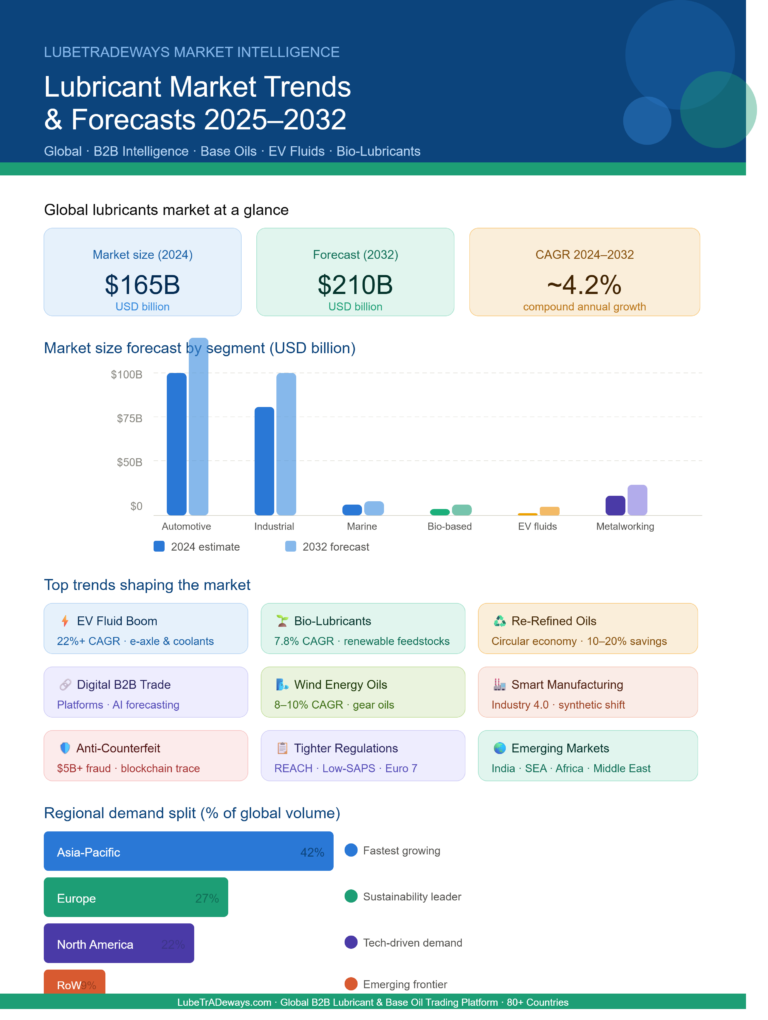
The global lubricants market was valued at approximately USD 165 billion in 2024 and is forecast to surpass USD 210 billion by 2032, growing at a compound annual growth rate (CAGR) of approximately 3.5–4.2% over the forecast period. By volume, global lubricant demand stands at around 39–40 million metric tonnes per year, a figure that reflects the enormous industrial and transportation machinery base that depends on these products daily.
Lubricants remain one of the most essential specialty chemicals in global commerce — touching virtually every sector of the modern economy, from automotive and aerospace to food processing, pharmaceuticals, renewable energy, and marine shipping.
Key Growth Segments to Watch
While the overall market grows steadily, several high-velocity sub-segments are dramatically outpacing the average:
- Bio-based and biodegradable lubricants — growing at 5–7% CAGR
- Electric vehicle (EV) fluids — emerging category growing at 15%+ CAGR from a small base
- Synthetic and semi-synthetic industrial lubricants — growing at 5–6% CAGR driven by precision manufacturing
- Wind turbine gear oils — growing at 8–10% CAGR as renewable energy capacity expands
- Food-grade lubricants — growing at 4.5–5.5% CAGR driven by food safety regulations
Understanding which segments are growing fastest — and why — is the first step for traders and suppliers looking to position their portfolios for maximum market relevance.
Top 10 Lubricant Market Trends Every Industry Professional Must Track in 2025
1. The Electric Vehicle Disruption: A Challenge AND an Opportunity
No single trend is generating more strategic discussion in the lubricant industry right now than the global transition to electric vehicles (EVs). On the surface, EVs appear to threaten lubricant demand — they eliminate engine oil changes, require no transmission fluid in many configurations, and use far fewer moving drivetrain components than internal combustion engine (ICE) vehicles.
However, the reality is far more nuanced. EVs create significant new lubricant demand categories:
- E-fluids for electric drivetrains — specialized lubricants for integrated motor-gearbox-inverter units (e-axles) that must handle high-speed operation, electrical compatibility, and thermal management simultaneously
- Thermal management fluids — dielectric coolants for battery pack thermal regulation, a completely new product category
- Greases for electric motor bearings — engineered to resist electrical current passage and high rotational speeds
- Chassis and brake system lubricants — which remain relevant regardless of powertrain type
For lubricant manufacturers and traders, the EV transition demands parallel product development strategies: defending ICE lubricant volumes through performance differentiation while aggressively building EV fluid capabilities and commercial relationships with EV OEMs and their supplier networks.
LubeTrADeways Insight: EV fluid volumes remain a fraction of ICE lubricant volumes through 2030 in absolute terms, but they command significantly higher average selling prices — making them highly attractive for specialty lubricant suppliers focused on margin, not just volume.
2. Sustainability and Bio-Lubricants: From Niche to Mainstream
Environmental sustainability has moved from a marketing checkbox to a genuine commercial driver in the lubricant industry. Driven by the European Green Deal, US EPA regulations, extended producer responsibility (EPR) mandates, and corporate net-zero commitments cascading through supply chains, demand for bio-based, re-refined, and biodegradable lubricants is accelerating rapidly.
Bio-lubricants — derived from vegetable oils such as canola, sunflower, and soybean, or from synthetic esters derived from renewable feedstocks — offer several key advantages over conventional petroleum-based products:
- Superior biodegradability (>60% within 28 days for many formulations)
- Lower aquatic toxicity
- Excellent natural lubricity and high viscosity index
- Reduced volatile organic compound (VOC) emissions
- Favorable carbon footprint credentials for ESG reporting
The global bio-lubricants market, valued at around USD 3.2 billion in 2024, is projected to reach USD 5.5–6.0 billion by 2032 — making it one of the fastest-growing segments in the entire specialty lubricants landscape.
Key application areas driving bio-lubricant adoption include forestry equipment, agricultural machinery, marine applications, construction equipment, and food-grade industrial uses — all sectors where lubricant spills or leaks create direct environmental contact risks.
3. Re-Refined Base Oils: The Circular Economy Enters the Lubricant Supply Chain
Re-refined base oils (RRBO) — produced by processing used engine and industrial oils through advanced hydroprocessing and distillation — are gaining significant traction as both a sustainability solution and a competitive commercial alternative to virgin base oils.
Modern re-refining technology, when properly executed, produces base oils meeting or exceeding Group II quality specifications — capable of formulating high-performance finished lubricants across many applications. Market leaders including Safety-Kleen, Avista Oil, and ENEOS are scaling re-refining capacity significantly.
For lubricant traders and formulators, RRBO offers several strategic advantages:
- Typically priced 10–20% below comparable virgin base oils
- Strong sustainability credentials for circular economy reporting
- Increasingly accepted by major lubricant OEM approval holders
- Growing feedstock availability as used oil collection infrastructure expands
In Europe, regulatory momentum through the EU Circular Economy Action Plan is creating formal targets for recycled content in lubricants — signaling that RRBO will become a baseline expectation, not a premium differentiator, for many applications within the next decade.
4. Base Oil Market Dynamics: Group II and III Continue to Displace Group I
The structural shift in global base oil production from Group I to Group II and Group III continues to reshape the lubricant supply chain. Group I base oils — produced by solvent refining — are steadily losing market share as refineries upgrade to hydroprocessing and hydrocracking technologies that produce cleaner, higher-performing Group II and III base stocks.
Current base oil market dynamics (2025):
- Group I — Declining share, now below 30% of global production; still dominant in some developing markets and certain industrial applications
- Group II — The dominant category globally; capacity continues to expand, particularly in Asia and the Middle East
- Group III — Growing rapidly driven by demand for full-synthetic and long-drain engine oils; South Korean (SK, GS Caltex) and Middle Eastern (ADNOC) producers are major suppliers
- Group IV (PAOs) — Premium synthetics commanding highest prices; demand driven by EV fluids, aerospace lubricants, and high-performance automotive applications
- Group V — Diverse specialty base stocks including esters, PAGs, and naphthenics serving specialty industrial and bio-lubricant applications
For lubricant traders sourcing base oils, understanding this structural shift and building relationships with Group II/III/IV suppliers is essential for competitive product formulation and long-term supply security.
5. Digital Transformation of the Lubricant Supply Chain
The lubricant trading and distribution industry — historically relationship-driven and paper-heavy — is undergoing rapid digital transformation. From online B2B trading platforms (like LubeTrADeways) to AI-powered demand forecasting, blockchain-enabled supply chain traceability, and IoT-connected lubricant monitoring systems, digitalization is reshaping how lubricants are bought, sold, and managed globally.
Key digital trends transforming lubricant trade include:
B2B Digital Marketplaces — Online platforms enabling buyers and sellers to discover, negotiate, and transact lubricant and base oil trades across geographies without traditional intermediary layers.
AI-Driven Demand Forecasting — Machine learning algorithms processing production schedules, equipment age data, and historical consumption patterns to predict lubricant needs with unprecedented accuracy — reducing both overstock and stockout risks.
Blockchain for Lubricant Authentication — Distributed ledger technology enabling end-to-end traceability of lubricant quality, origin, and handling — critical for combating the multi-billion-dollar counterfeit lubricant problem that plagues markets in Asia, Africa, and Latin America.
IoT Condition Monitoring — Sensors embedded in critical equipment automatically monitoring lubricant condition (viscosity, contamination, oxidation) and triggering replenishment orders before failure occurs — enabling predictive rather than reactive maintenance.
6. Renewable Energy Sector Creating New Lubricant Demand Streams
The global energy transition is generating substantial new lubricant demand from renewable energy infrastructure — particularly wind power, solar panel tracking systems, and hydroelectric equipment. Wind turbines represent the most significant opportunity:
A single onshore wind turbine requires approximately 400–700 liters of specialized gear oil for its main gearbox, with change intervals of 3–5 years. An offshore turbine may require 1,000–2,000 liters of premium gear oil with even more demanding performance specifications due to remote, difficult service conditions.
With global installed wind capacity expected to more than double by 2032 — from approximately 1,000 GW today to over 2,000 GW — the incremental lubricant demand from wind energy alone will be substantial. Wind turbine gear oils must provide exceptional oxidation stability, water resistance, micropitting protection, and extremely long service life — placing them firmly in the premium synthetic lubricant category.
Solar tracking systems, hydroelectric turbines, and tidal energy installations add further layers of specialty lubricant demand across the renewable energy spectrum.
7. Industrial Automation and Smart Manufacturing Driving Premium Lubricant Demand
Industry 4.0 — the integration of robotics, artificial intelligence, advanced CNC machining, and interconnected smart factories — is fundamentally reshaping industrial lubricant requirements. Highly automated manufacturing environments demand lubricants that:
- Deliver consistent, predictable performance over extended drain intervals to minimize maintenance disruptions
- Are compatible with automated oil analysis and condition monitoring systems
- Provide enhanced protection during the high-speed, high-precision operations characteristic of modern CNC machining centers
- Meet increasingly stringent cleanliness standards (ISO cleanliness codes) for hydraulic systems in advanced manufacturing
This push toward automation is accelerating the substitution of conventional mineral oil lubricants with premium synthetic formulations — driving average selling price improvement even as total consumption volumes stabilize or decline in some industrial sub-sectors.
8. Counterfeit Lubricant Problem: A $5 Billion+ Market Threat
One of the most significant yet underreported challenges facing the global lubricant industry is the enormous counterfeit lubricant problem. Industry estimates suggest that counterfeit and substandard lubricants represent 5–15% of the lubricant market by volume in some regions — with Asia, Africa, and Latin America being the most heavily affected.
The consequences are severe: counterfeit lubricants cause premature equipment failure, increased maintenance costs, voided warranties, and in industrial settings, potentially catastrophic equipment breakdowns. For legitimate lubricant brands, the financial and reputational damage is enormous.
The counterfeit lubricant problem creates both a risk and an opportunity for B2B traders. Sourcing exclusively through verified, authenticated supply chains — and being able to demonstrate product authenticity to buyers — is becoming a major competitive differentiator for responsible lubricant trading platforms. This is an area where digital authentication technologies and trusted B2B marketplace verification are delivering real commercial value.
9. Regulatory Landscape: Tightening Standards Reshaping Formulations
Regulatory developments across major markets are creating significant formulation pressure for lubricant manufacturers:
REACH (EU) — Continued restriction of hazardous chemical components in lubricant formulations, including certain antiwear additives, heavy metal compounds, and chlorinated paraffins.
GHS/SDS compliance — Global harmonization of safety data sheet requirements creating formulation and documentation compliance burdens, particularly for smaller lubricant manufacturers.
Low-SAPS engine oil mandates — European emission standards (Euro 6d, incoming Euro 7) require lubricants with extremely low sulfated ash, phosphorus, and sulfur (SAPS) content to protect diesel particulate filters and catalytic converters.
OEM approval proliferation — Automotive and equipment OEMs continue to expand proprietary lubricant approval programs (VW 508.00/509.00, MB 229.71, Dexos2, etc.) — requiring lubricant formulators to maintain a growing number of costly OEM approval licenses.
Bio-content mandates — France and several other EU countries are progressively introducing mandatory minimum bio-content requirements for certain lubricant applications, with broader EU-level measures anticipated post-2027.
10. Emerging Markets: Asia, Africa, and the Middle East Driving Volume Growth
While mature markets in Europe and North America represent technology leadership and sustainability drivers, volume growth in the global lubricant market is overwhelmingly driven by emerging economies.
India is emerging as one of the most exciting lubricant market growth stories globally. Automotive production is booming, manufacturing capacity is expanding rapidly, and lubricant per-capita consumption — still far below developed market levels — has significant room to grow. The Indian lubricant market, currently valued at approximately USD 3.5 billion, is projected to approach USD 5 billion by 2030.
Southeast Asia — particularly Indonesia, Vietnam, Thailand, and the Philippines — is experiencing rapid motorization and industrialization. These markets are characterized by strong two-wheeler and commercial vehicle lubricant demand, growing industrial lubricant needs, and increasing consumer awareness of quality lubricants.
Africa represents a longer-term frontier opportunity, with urbanization, infrastructure development, and mobile equipment deployment driving lubricant demand growth across sub-Saharan markets. Nigeria, South Africa, Kenya, and Egypt are the most significant current markets on the continent.
The Middle East — beyond being a major base oil producing region — is a growing lubricant consumer market, particularly for industrial applications tied to petrochemical, desalination, and construction equipment.
Base Oil Price Outlook 2025: What Traders Need to Know
Base oil prices — which typically represent 60–80% of finished lubricant production costs — are subject to complex price dynamics influenced by crude oil costs, refinery utilization rates, seasonal demand patterns, and regional supply-demand imbalances.
Key base oil pricing factors for 2025:
Crude Oil Correlation — Base oil prices remain broadly correlated with crude oil price movements, though the relationship has weakened somewhat as bio-based and re-refined alternatives provide partial price anchors.
Group II Oversupply Risk — Significant Group II base oil capacity additions, particularly in Asia-Pacific and the Middle East, create downward price pressure in the medium term. Traders sourcing Group II should be alert to regional arbitrage opportunities.
Group III Tightness — Group III base oil supply remains relatively constrained relative to growing demand from synthetic engine oil formulations, keeping Group III pricing at a premium. Supply is dominated by a small number of large producers (SK Enmove, GS Caltex, ADNOC Refining), giving sellers significant pricing power.
PAO (Group IV) Premium Stability — PAO prices command a substantial premium over mineral base oils and are expected to remain elevated given strong demand from EV fluid formulations, aerospace lubricants, and premium automotive applications.
Naphthenic Base Oils — Specialty naphthenics remain critical for transformer oils, process oils, and certain refrigeration lubricant applications; prices are influenced by a distinct supply base from conventional Group I/II producers.
LubeTrADeways Market Intelligence: Sectors to Watch in 2025–2026
As the B2B lubricant trade community’s most trusted intelligence platform, LubeTrADeways identifies the following sectors as offering the highest commercial opportunity for lubricant suppliers, buyers, and distributors in 2025–2026:
Wind Energy Gear Oils — Premium synthetic gear oils for growing installed wind capacity; long-term supply contracts with turbine OEMs and fleet operators represent high-value opportunities.
EV Thermal Management Fluids — Dielectric coolants and e-axle fluids for the booming EV manufacturing sector; early positioning with EV manufacturers and tier-1 suppliers delivers significant first-mover advantage.
Food-Grade Lubricants — Growing regulatory requirements for NSF H1 food-grade lubricants across food and beverage processing; fragmented buyer base creates distribution opportunities.
Mining & Heavy Equipment Lubricants — Commodity price recovery is driving increased global mining activity; demand for long-drain, extreme pressure gear oils and hydraulic fluids serving mining equipment is growing strongly.
Marine Lubricants — IMO 2020 sulfur cap compliance and emerging LNG and methanol-fueled vessel requirements are creating demand for new-generation marine cylinder oils and system oils.
How LubeTrADeways Connects the Global Lubricant Trade
At LubeTrADeways, we’ve built the lubricant industry’s most dynamic B2B trading ecosystem — connecting lubricant manufacturers, base oil suppliers, additive companies, distributors, and end-users across more than 80 countries.
Our platform delivers:
Verified Supplier Network — Every supplier and buyer on LubeTrADeways undergoes a rigorous verification process — so you trade with confidence, not risk.
Real-Time Market Intelligence — Base oil prices, lubricant market news, regulatory updates, and trade data delivered directly to platform users — the market intelligence edge that drives better buying and selling decisions.
Direct RFQ & Trade Matching — Post requirements or product listings and receive qualified responses from verified counterparties — eliminating cold outreach and accelerating deal cycles.
Industry-Specific Product Categories — From automotive and industrial lubricants to marine, aviation, food-grade, and specialty products — LubeTrADeways covers the full spectrum of the lubricant trade.
Expert Content & Analysis — In-depth market reports, trend analysis, supplier profiles, and technical guides — keeping the LubeTrADeways community informed and ahead of market developments.
Whether you’re a lubricant manufacturer seeking new export markets, a distributor building your supply portfolio, or an industrial buyer optimizing your lubricant sourcing strategy — LubeTrADeways is your competitive advantage in the global lubricant trade.
Forecast Summary: Lubricant Market Outlook by Segment (2025–2032)
| Segment | 2024 Market Value | 2032 Forecast | CAGR |
|---|---|---|---|
| Automotive Lubricants | ~USD 72B | ~USD 90B | ~3.0% |
| Industrial Lubricants | ~USD 55B | ~USD 72B | ~3.5% |
| Marine Lubricants | ~USD 5.5B | ~USD 7.2B | ~3.5% |
| Aviation Lubricants | ~USD 1.8B | ~USD 2.8B | ~5.5% |
| Bio-Based Lubricants | ~USD 3.2B | ~USD 5.8B | ~7.8% |
| EV Fluids | ~USD 0.9B | ~USD 4.5B | ~22%+ |
| Metalworking Fluids | ~USD 10.2B | ~USD 15.4B | ~4.7% |
| Total Lubricants Market | ~USD 165B | ~USD 210B | ~3.5–4.2% |
Note: Values are approximate estimates based on publicly available industry research.
Conclusion: Position Your Business for the Lubricant Market of Tomorrow
The global lubricant industry is in the midst of a profound transformation — driven by electrification, sustainability imperatives, digital disruption, and the emergence of entirely new application segments that didn’t exist a decade ago. For lubricant buyers, sellers, and traders, the businesses that thrive through this transition will be those that:
Stay informed — Understanding market trends, base oil dynamics, regulatory shifts, and emerging application categories before competitors do is the most powerful strategic advantage available.
Adapt product portfolios — Expanding into high-growth categories like bio-lubricants, EV fluids, wind energy lubricants, and food-grade products while maintaining competitiveness in core segments.
Leverage digital platforms — Using B2B digital marketplaces like LubeTrADeways to access verified counterparties, real-time market data, and efficient trade execution — dramatically improving supply chain speed, cost, and reliability.
Build trusted supply chains — In a market challenged by counterfeit products and quality inconsistency, verified, traceable supply chains are not just good practice — they’re a commercial differentiator.
Think globally, trade smartly — The best lubricant market opportunities in 2025 and beyond are increasingly cross-border. The ability to identify, evaluate, and execute international lubricant trade efficiently is a core business capability for the next generation of lubricant market leaders.
At LubeTradeways, we’re here to help you navigate every dimension of this dynamic market — with the intelligence, connections, and platform capabilities to help your business win in the global lubricant trade.
Frequently Asked Questions (FAQs)
Q1. What is the current size of the global lubricants market in 2025? The global lubricants market is estimated at approximately USD 165–170 billion in 2024–2025 by value, with total volume demand of around 39–40 million metric tonnes annually.
Q2. Which lubricant segment is growing the fastest? EV fluids (e-axle fluids, thermal management fluids, EV-specific greases) are growing fastest from a percentage standpoint at 15%+ CAGR, while bio-based lubricants lead among established segments at 6–8% CAGR.
Q3. How is the electric vehicle transition affecting lubricant demand? EVs reduce engine oil demand but create significant new demand for e-axle fluids, dielectric coolants, specialized greases, and thermal management fluids — which command premium pricing. The net effect on lubricant market value is modest because EV fluid pricing partially offsets engine oil volume declines.
Q4. What are the key lubricant industry trends for 2025? The top trends include EV fluid development, bio-lubricant growth, re-refined base oil adoption, base oil quality upgrading (Group I to II/III shift), digital B2B trading platform adoption, wind energy lubricant demand, and tightening regulatory requirements.
Q5. What is the difference between Group I, Group II, and Group III base oils? Group I base oils are produced by solvent refining and have the lowest purity; Group II are hydroprocessed for higher purity and better oxidation stability; Group III are severely hydrocracked or hydroisomerized to produce near-synthetic quality base stocks. Higher groups command higher prices and enable longer-drain and higher-performance lubricant formulations.
Q6. How can I buy or sell lubricants on LubeTrADeways? LubeTrADeways is a B2B lubricant trading platform where verified manufacturers, distributors, and buyers can list products, post purchasing requirements, and connect for direct trade. Register on our platform to access the global lubricant trade community and our real-time market intelligence resources.
Q7. Which regions offer the best lubricant market growth opportunities in 2025? India, Southeast Asia (Indonesia, Vietnam, Thailand), Sub-Saharan Africa, and the Middle East offer the strongest volume growth opportunities. Europe and North America offer the best opportunities in premium and specialty lubricant segments including bio-lubricants, synthetics, and EV fluids.
Q8. What are bio-based lubricants and why are they growing? Bio-based lubricants are derived from renewable raw materials such as vegetable oils or synthetic esters from bio-feedstocks. They are growing rapidly due to stricter environmental regulations, biodegradability requirements in sensitive applications, and corporate sustainability commitments driving OEM and end-user specification updates.